Wednesday, March 16, 2011

Are we ready when earthquakes and tsunamis strike?


As of today,  hundreds of people are found dead and countless  are missing in Japan after being hit by M8.9 earthquake and the east coast cities and towns were savaged by a 13 meter-high tsunamis. That was the worst earthquake in Japan. 
The earthquake and tsunamis had created a whirlpool in seabed of Fukushima
 At least Japan has developed earthquake-proof buildings, and synchronized alarm systems that have helped evacuated millions of people before the tsunamis savaged the city. If not, maybe millions of dead people will float in the coasts of their cities. Remember, Tokyo alone has 30 million populations.
The busy city of Sindai, caught by a tsunami
Philippines is so blessed. Although we are in the so called “ring of fire,” we did not experience as big as this natural disaster. I cannot figure out if this happened to our country, maybe millions of people will die. Thanks God! 
A disastrous tsunamis heavily savaged this village
Yet, Japan’s disaster is a precaution to us. Such catastrophe may happen to us anytime, anywhere.
The question is how ready are we if these calamities strike our country? 
The shanty area of Manila, with  thousands of poor Filipinos living in poverty
In the Philippines, look at the shanty areas along the coastal areas of Metro Manila where millions of impoverished Filipinos are living. Though they are aware of the danger but  still, they risk their lives of staying along the seashore or they will die in hunger. 

Along the seeashore, our impoverished Filipinos squate riskily
According to Architect Palapoc, one of the best architects in the Philippines, it is safer to stay in a high-rise building rather than being trapped in a three or two storey edifice. He said, at least the government is strict in implementing the policies for tall buildings but not in low-rise structures. 
Philippines is too prone for tsunamis, too. Yet, people choose to live along the bayside for their daily living. 
The very poor conditions of houses prune to eartquake, fire and even tsunamis
Our concern is not only about taking care of the environment because natural disaster strikes like a thief in the night. Readiness and saving lives are among the key concerns we have to do.
Are we prepared when earthquakes come?  At least we can be warned with tsunamis yet nobody knows when earthquakes will strike. Nobody knows!
Imagine if an earthquake and tsunamis strike this city?
Earthquakes, tsunami, volcanic eruption, will be with us forever. They happened in the past and they will happen tomorrow and the next millions of years hence.
We can only hope that the Earth sciences of geology, seismology and related fields will keep improving in order to allow us to better understand and better prepare for the impending natural geological movements.

Again, are you ready when tsunamis and earthquake strike?

Monday, March 7, 2011

VOX POPULI: WHAT’S WAITING TO OUR MID-EAST OFWs?

Millions of Filipinos leave the country to find a descent living in foreign lands. Approximately, there are nearly 11 millions of OFWs worldwide. Majority of them are domestic helpers and personal service workers. Others work as doctors, physical therapists, nurses, accountants, IT professionals, engineers, architects, entertainers, technicians, teachers, military servicemen, seafarers, students and caregivers.
Significantly, they had contributed a lot to the Philippine economy. In 2009, about US$17.348 billion in remittances was sent to the Philippines by overseas Filipino representing 13.5% of the country’s GDP.


More than 4 million OFWs are in the United States and 500 thousands are in Canada.
Europe became a working place and an alternative home for Filipinos. The UNited Kingdom is home to around 200,000 OFWs, while Italy has 131,000 Filipino migrants. Spain has 40,000; Greece , 40,000; Ireland, 11,500 and Norway, 12,000.


Australia has 127, 000 and New Zealand has 17, 000.


In our Asian neighboring countries, most OFWs are in Japan, 250,000; Singapore, over 150,000; Hongkong 140,000; Taiwan, 160,000 and South Korea, over 70,000;


Filipinos make up about 30% of the entire population of Sabah and they enumerate up to 900,000. They work in construction industries, fisheries, and other labor intensive sectors in hopes of a better living. Sad to say, they squatted in slum areas.


In the desert, we have more than 2 millions of OFWs mostly in Saudi Arabia and UAE. 3,000 mostly men working in military bases in Iraq. As many as 30,000 OFWs are in Lebanon. 28,000 OFWs are in Libya, Egypt, Bahrain, and Yemen. These countries are in political unrest.


Albay Gov. Joey Salceda urged the government to pass a P750 million emergency supplemental budget for the repatriation of OFWs in the affected mid-east countries.


Statistics show that there are 669,042 OFWs in the Middle East of which 28,000 Filipinos are working in Libya with 10,383; Bahrain – 15,001; Yemen – 1,417 and Egypt with 483 Filipino workers. These countries are currently under volatile political situation.


With the repatriation of 28,000 OFWs in the Middle East,  the country would loss $112 million in yearly remittances which could give a negative impact to the country’s economy.
At least the Aquino government aimed at “Zero Casualty” among our OFWs who were caught by the rising conflict in the Middle East.


As of today, our forced balikbayans continue to surge in the NAIA terminal. Thanks God, they are home safe now. Some went home unpaid of their salaries. They are getting at least P10,000 from OWWA and a promise that there are jobs waiting for them in the Philippines.


It is a sad reality, that Filipinos get greener pasture in foreign lands.  The Philippines is endowed with rich natural resources and skilled human race but cannot earn descent living here! Why?


While Philippines is said to be a champion of freedom and democracy, it is evident that people do not enjoy the material blessings of a free economy because of unbridled corruption in the government.


Rich countries in Middle East are fighting to overthrow dictatorship in their governments, but the Philippines is impliedly suffering totalitarianism in most local governance.


How many decades our local governance mostly in far flung provinces is being controlled by few, rich families? In reality, it seems that position in the government is something that is inherited. Are our leaders being elected based on their performance? Or, is it because they have more pesos to buy votes during election?


If our leaders performed well, there were no 11 million Filipinos who submit to be enslaved abroad in exchange of bread and honey.


Our desire is to see our people transformed into a group of performance-oriented community who install leaders based on what they achieved and what they can contribute for the betterment of the country.


I believe in the saying, “What starts well, ends well.” If we want a truly prosperous community, we should start promoting clean and good governance now!

Wednesday, March 2, 2011

Who's to be blamed?


As requested by some of my readers, I am now updating my blog with my articles published in my opinion column, VOX POPULI  in BUSINA BIKOL NEWS EXPRESS.

Filipinos are no excuse to the political chaos the world is  experiencing today particularly in the Middle east. 

Libya is in the headline of most international media because of the conflict between Gaddafi government and the protesters. As of today more than a thousand  people were dead because of this unrest. 

In Yemen President Ali Abdullah Saleh, who is now 32  years in power  is facing street demonstrations both from organized opposition parties demanding reforms.

In Bahrain, protests continue to surge as Shi'ite majority wants to overhaul the government and overthrow the al-Khalifa dynasty which ruled Bahrain for 200 years, and the family dominates a cabinet led by the king's uncle, who has been prime minister since independence from Britain in 1971.

We have thousands of OFWs in the Middle East who are seeking for a rescue.

Last week, we are bothered of Taiwan and Hongkong’s indifference to our OFWs. In China, many overseas Filipinos workers are in death row because of drug-related crimes.

These are the undesirable situations our OFWs, our biggest revenue providers are facing today.
Although, President Aquino with his administration is also addressing these problems but its negative effect to our OFWs and to their families can never be under-estimated. As Filipinos, they deserve to have a peaceful life. Out of the country, they sacrificed to earn a living for their family because our government failed to provide them a better employment in their own land.

Last February 25, we celebrated EDSA People Power – the day that gave the Filipino people a big hope that Philippines will be a better country after it. Democracy has been restored! After two decades and a half, Philippines became one of the poorest countries in the world and I think the least improved nation in the Southeast Asian region.

Look around you. Who are getting richer and who gets poorer? Is this the kind of life our government is promising.

I believe, what is happening to us has the consent of our voting populace. We are embracing democracy, but during election most of us instantly submit themselves to be fooled by politicians who buy every vote either at P500 or P200, or even at a kilo of rice and a sardine.

Then, after the election people blamed the administration for incompetence and corruption. Abuse of power in the government is so deafening. Some of us became naïve and numb of malpractices in our government because of hopelessness.

I could say, we never learned from our lessons in the past. Unless we increase our self-worth and dignity, the kind of growth and development we desire for our country can never be attained.

Let us have a good start now. Increase self-respect and stand as men and women of democracy who are created by God with equal worth to anyone.

Sunday, October 10, 2010

CCDI champs in PCCL South Luzon- Bicol

CCDI: The Champion of South Luzon Bicol

 The Computer Communication Development Institute Wildcats marked 4-0 straight win in the recently concluded South Luzon – Bicol Championship of the Philippine Collegiate Champions League held last October 4 – 6, 2010 in Sorsogon Provincial Gymnasium. Such performance landed CCDI into the championship title of the South Luzon elimination.

Michael Adamos dominated the rebound against
the towers of Bicol College
CCDI did an impressive performance after sweeping the giant universities in South Luzon - Bicol area in the basketball league held last October 4 - 6, 2010 in Sorsogon Provincial Gymnasium, Sorsogon City. It has defeated the Manuel S. Enverga University of Lucena City, Ateneo de Naga Unveristy, Bicol College and Amando Cope College of TAbaco City

Dharen Lacdao, Wildcats captain ball did his defensive role 
to his team Wildcats
The CCDI Wildcats upset the Bicol College Maroons with a score of 90 - 63 in the final game. The Maroons were rattled of the run and gun offense strategy of the Wildcats.

The leap and the power of Adamos, an advantage of the
Wildcats.
 Michael Adamos lead the Wildcats’ score making 16 points. Julius Jayona also did an impressive performance of 13 points. Jay Diesta and Shelby Gobris helped the scoring with 12 and 13 points, respectively in this regional tilt sponsored by the Rotary Club of Metro Sorsogon and Rotary Club of Pasig Sunrise.

“I am happy to say that Sorsogon college basketball has improved a lot. This team, though composed of a small lineup is characterized of great courage and huge heart for basketball, that is why they win,” said by Coach Joe Lipa, PCCL Executive Director.

Man-to man defense: The brick of the game
 Coach Ron Ryan Jalmanzar took the advantage of his power point guard, Shelby Gobris who orchestrated the game dominating the Maroons point guards in this league brought by Smart Communications and PLDT.


Basketball is not all about height. It's about heart.
 The Maroons were unsuccessful of making use of their height advantage over the Wildcats who did sustain stamina until the last quarter of the game. The lead continue to escalate as the key players of the Bicol College dropped to the ground one by one, when Coach Ron use his trapping defense and running attack.

Visuals, reflections must be used to win the game

Coach Ron, his authority over his men supreme in court.
 The Manuel S. Enverga University Foundations, Inc. landed runner-up for making 3-1 game standing. Enverga U failed to bring home the coveted championship trophy because of its defeat against CCDI Wildcats in the opening game.


The Ateneo de Naga University Knights submerged to fourth rank with 1-3 standing. The Knights were heavily savaged by CCDI with a score of 61-79. Ateneo was followed by Amando Cope College with 0-4 record.

Shelby Gobris was declared the Most Valuable Player while Julius Jayona (CCDI), Avila (Ateneo) Pelaez (Enverga) and Salinas (Bicol College) were rowed in the Mythical Five

Vice Mayor Bobet, Coach JOa Lipa and Sir Edgar Balasta
entertained, learned from the enigma of this game.


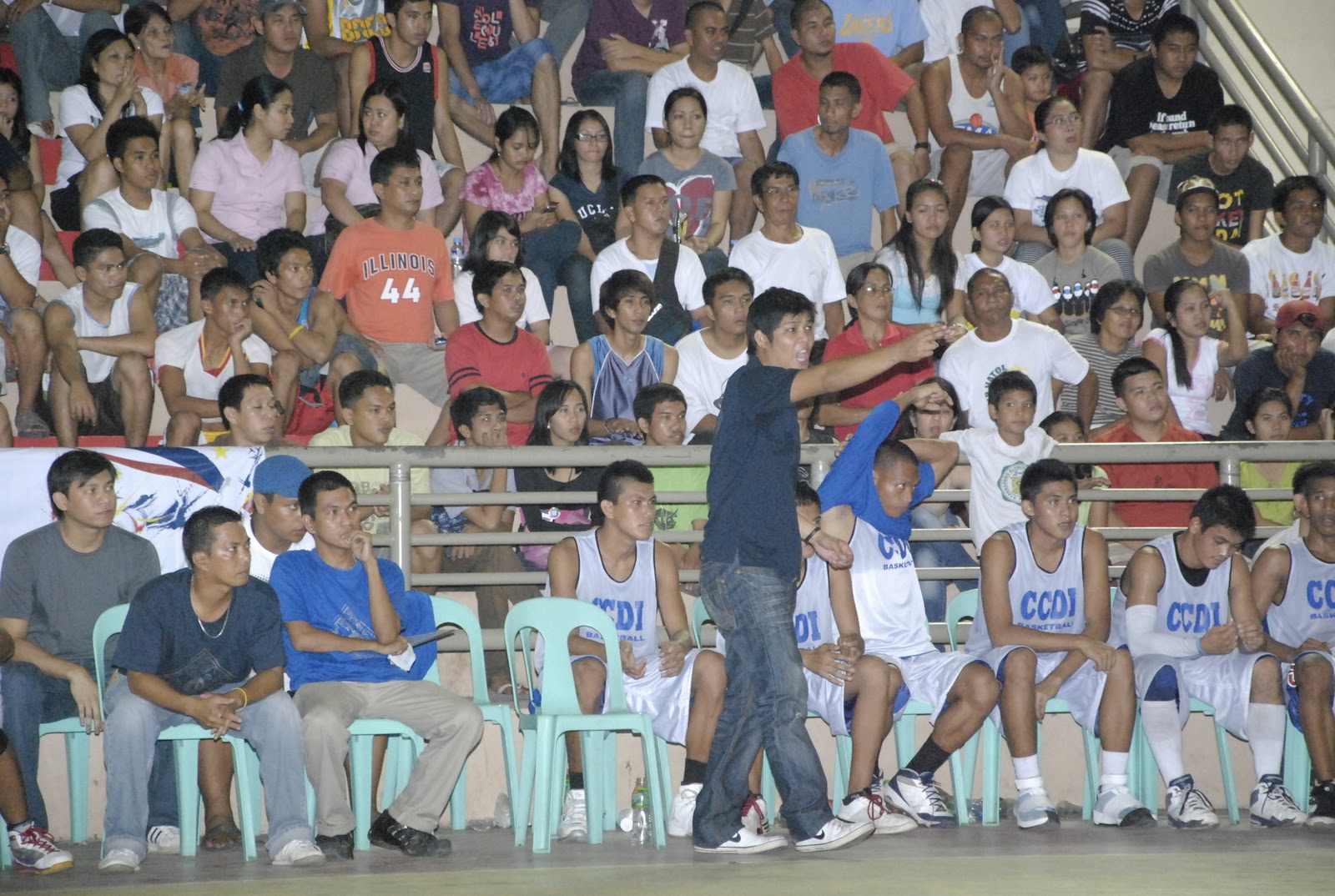
The sixth man of the game, its the crowd.

The Wildcats, inspired to play as the faculty memebrs and students
cheer for them.

Almost near to championship! Coach Ron, happy... very happy!

The celebration.. the cheers... it pumps up!

“PCCL is my most awaited league. I know how strong our opponents are. That is why, I keep my stamina strong. Thanks God, our sacrifices worked,” Gobris exclaimed.


“PCCL has helped developed our team become more competitive. My team knew where they will be going. They always look up to challenging UAAP and NCAA teams,” quoted by Coach Ron Jalmanzar.

The joy! Afther hardship... it's success!


The Wildcats, subsiding energies after the game.
It was the best game so far!


Together.. we won!

The mythical five... the MVP... Shelby Gobris


The Mythical Five: Shelby (CCDI) Julius Jayona (CCDI), Pelaez (Enverga), Salinas (BC)
and Avila (Ateneo)

It takes two to tango.. the MVP and the Best Coach

We started as One..
We win as One...

Life is worth celebrating for!

A snap photo with the father of collegiate basketball...
Coach Joe Lipa.
 The CCDI Wildcats will represent the South-Luzon in the Zonal Elimination which might be scheduled on November 8 – 12 to be held in ULTRA, Pasig City. Expected to compete with CCDI are National University and the University of Manila.


The future of Sorsogon Basketball
... Dandan and Mark


Proud to be our home grown  coach, Ron Ryan Jalamanzar
Player noon... BEst coach na ngayon!
It has been noted that CCDI was the Bicol’s official delegation for basketball men of the CHED National Games held in Manila last February, 2010.

Tuesday, March 9, 2010

CCDI experiences in CHED Games 2010

CCDI delegation composed of 20 participants , had valuable experiences in CHED Games 2010 that deserves to be shared of.

Our learning from this game has molded us become better athletes and sports leaders. Nevertheless, the throttling discomfort and dismay due to lack of preparation and proper communication cannot be disregarded as part of learning experiences.
CHED Games is an initiative of Sec. Emmanuel Y. Angeles through the NAHEI or National Higher Education Institutions participated b three biggest nationwide sports association, the Private School Athletic Association (PRISAA), State Colleges and Universities Association (SCUAA) and the Local Colleges and Universities Association (LCUAA).

Bicol delegation was confronted by tremendous challenges in its participation to CHED Games. Amongst the issues were:

1. Lack of funding support of CHED to the Regional delegations in which was not the usual arrangement in the previous PRISAA-SCUA unified games, specifically those that were held in 2004 in Bacolod City (as I personally experienced) and in the previous years. In my opinion the supposed assistance to sports has been given to the first-ever National Academic and Cultural Competition, which was again initiated by the CHED Secretary.
2. Due to the first concern, Ateneo de Naga University (with 6 athletes) and the Universidad de Sta. Isabel (44 athletes) back-out in the participation to CHED Games. USI still sent delegates to the Academic and Cultural Competition. For whatever reason they had, we do respect their non-support to CHED Games.

3. Bicol delegation was informed to have a shuttle service vehicle, but found out to have nothing in its arrival to the venue. The issue was eased, when Dr. Villanueva informed us that Sec. Angeles pledge to help the delegation who does not have their own transportation vehicle of the athletes during their actual games.

Bicol delegation is composed majority of athletes from PRISAA having almost, 90% of athletes and the rest from SCUAA (Bicol University and Bicol Central University of Agriculture) and LCUAA. I thank Atty, Marito Bernales, President of CBSUA for personally taking care of the Bicol Delegation. Director Peralta was so supportive to our delegation ensuring that our athletes are safe from harm and that everything is in order. He was backed up by his education supervisors, Dr. Manny Mendoza and Mr. Mediavillo.

Officials of the delegation were composed of five (5) from PRISAA, 19 from SCUAA and three (3) CHED officials. Yet, in the actual games, some of the officials did not arrive in the venue! I just wonder why there are more SCUAA delegation officials considering that most of the athletes are from private school.

Bicol team was housed in Philippine State College of Aeronautics (PhiISCA). Thanks to the generosity of Dr. Ramirez and the dedicated support of his staff, students and security personnel. Our security is strict, but we understand it’s for our athletes’ safety.

Expectedly, our athletes was discomforted by severe heat in Manila. The very warm temperature was weakening us. I think it was 37 Celsius. Thick dusts from the nearby ongoing construction of Marriott Hotel annoyed the athletes. As a regular occurrence in Metro Manila, water supply became scarce and was aggravated by El Nino phenomenon. PHILSCA maintenance immediately responded by asking the help of the Barangay 185 of Pasay City which supplied us additional water.

Our delegation was peaceful. At 10:00 pm, everyone is inside the billeting area. The security officers are checking regularly seeing that everyone is around.

At 4:00 am, most of the athletes are awake preparing to the action of the game…

After that restless night of March 21, we were entertained by its Opening Ceremonies held in Rizal Memorial Complex.


These performance from nearly 2,000 performers of PHILSCA really did amaze the particpating athletes and the crowd as well


Amids the heat of the sun, the delegates from 17 regions of the Philippine archipelago stayed during the Opening of CHEd Games.


Though some are frustrated of the absence of President GMA, who is supposed to be the Guest of Honor of the CHED Games. The Philippine President was in Palawan that time.


Western Visayas (Region VI)


Region 8: EasternSamar:


REgion 10: Northern Mindanao


Region 12: SOCCSKSARGEN

I should say one of the strongest competitor of NCR in sports is CEBU or Central Visayas. I really did admire the glamour and the personality of their delegation. It seems that there athletes are well-funded by their respective schools and LGUs.


REgion 7: Central Visayas


Region 5: Bicol Region

REgion 5 was not the smallest delegation in CHED Games despite of the absence of 44 USI athletes and 6 Ateneo de Naga athletes. Yet, our delegation was not as bubbly as the other regions.


I noticed that our parade attire is not uniform. Anyway, we have the same colors naman, black and gold.

I hope so, we should have brought our local leaders so they saw the difference of the sports of other regions compared with the Bicol Region.

Though we are pushing for sports development and its active integration in community activities, still our efforts became unwanted and less priorities.

Saturday, January 16, 2010

Haiti Earthquakes


I am supposed to post my new year's article here today, but I was so moved of what happened in Haiti the other day.

These are the exact information I got online through the New York Times and National Geopgraphic websites.

(This photo is uploaded from New York Times website)

Bodies lay by a street on Wednesday in downtown Port-au-Prince,
where the cries of trapped victims could be heard under rubble.


Haiti Lies in Ruins; Grim Search for Untold Dead
Damon Winter/The New York Times

Haiti — Survivors strained desperately on Wednesday against the chunks of concrete that buried this city along with thousands of its residents, rich and poor, from shantytowns to the presidential palace, in the devastating earthquake that struck late Tuesday afternoon.

Calling the death toll “unimaginable” as he surveyed the wreckage, Haiti’s president, René Préval, said he had no idea where he would sleep. Schools, hospitals and a prison collapsed. Sixteen United Nations peacekeepers were killed and at least 140 United Nations workers were missing, including the chief of its mission, Hédi Annabi. The city’s archbishop, Msgr. Joseph Serge Miot, was feared dead.

And the poor who define this nation squatted in the streets, some hurt and bloody, many more without food and water, close to piles of covered corpses and rubble. Limbs protruded from disintegrated concrete, muffled cries emanated from deep inside the wrecks of buildings — many of them poorly constructed in the first place — as Haiti struggled to grasp the unknown toll from its worst earthquake in more than 200 years.

In the midst of the chaos, no one was able to offer an estimate of the number of people who had been killed or injured, though there was widespread concern that there were likely to be thousands of casualties.

(Uploaded from National Geopgraphic site)


“Please save my baby!” Jeudy Francia, a woman in her 20s, shrieked outside the St.-Esprit Hospital in the city. Her child, a girl about 4 years old, writhed in pain in the hospital’s chaotic courtyard, near where a handful of corpses lay under white blankets. “There is no one, nothing, no medicines, no explanations for why my daughter is going to die.”

Governments and aid agencies from Beijing to Grand Rapids began marshaling supplies and staffs to send here, though the obstacles proved frustrating just one day after the powerful 7.0-magnitude earthquake hit. Power and phone service were out. Flights were severely limited at Port-au-Prince’s main airport, telecommunications were barely functioning, operations at the port were shut down and most of the medical facilities had been severely damaged, if not leveled.
A Red Cross field team of officials from several nations had to spend Wednesday night in Santo Domingo in the Dominican Republic to gather its staff before taking the six-hour drive in the morning across the border to the earthquake zone.

“We were on the plane here with a couple of different agencies, and they all are having similar challenges of access,” Colin Chaperon, a field director for the American Red Cross, said in a telephone interview. “There is a wealth of resources out there, and everybody has the good will to go in and support the Haitian Red Cross.”

(Uploaded from National Geopgraphic site)
The Presidential Palace after strucked by the earthquake

The quake struck just before 5 p.m. on Tuesday about 10 miles southwest of Port-au-Prince, Haiti’s capital, ravaging the infrastructure of Haiti’s fragile government and destroying some of its most important cultural symbols.
“Parliament has collapsed,” Mr. Préval told The Miami Herald. “The tax office has collapsed. Schools have collapsed. Hospitals have collapsed. There are a lot of schools that have a lot of dead people in them.”
He added: “All of the hospitals are packed with people. It is a catastrophe.”
President Obama promised that Haiti would have the “unwavering support” of the United States.
Mr. Obama said that United States aid agencies were moving swiftly to get help to Haiti and that search-and-rescue teams were en route. He described the reports of destruction as “truly heart-wrenching,” made more cruel given Haiti’s long-troubled circumstances. Mr. Obama did not make a specific aid pledge, and administration officials said they were still trying to figure out what the nation needed. But he urged Americans to go to the White House’s Web site, http://www.whitehouse.gov/, to find ways to donate money.
“This is a time when we are reminded of the common humanity that we all share,” Mr. Obama said, speaking in the morning in the White House diplomatic reception room with Vice President Joseph R. Biden Jr. at his side.

(Uploaded from National Geopgraphic site)
The Haiti downtown was savaged by the earthquake
Aid agencies said they would open their storehouses of food and water in Haiti, and the World Food Program was flying in nearly 100 tons of ready-to-eat meals and high-energy biscuits from El Salvador. The United Nations said it was freeing up $10 million in emergency relief money, the European Union pledged $4.4 million and groups like Doctors Without Borders were setting up clinics in tents and open-air triage centers to treat the injured.
Supplies began filtering in from the Dominican Republic as charter flights were restarted between Santo Domingo and Port-au-Prince.
Some aid groups with offices in Port-au-Prince were also busy searching for their own dead and missing.
Sixteen members of the United Nations peacekeeping force in Haiti were killed and as many as 100 other United Nations employees were missing after the collapse of the mission’s headquarters in the Christopher Hotel in the hills above Port-au-Prince.
Forty or more other United Nations employees were missing at a sprawling compound occupied by United Nations agencies. Ten additional employees had been in a villa nearby.

(Uploaded from National Geopgraphic site)

It was one of the deadliest single days for United Nations employees. The head of the group’s Haitian mission, Mr. Annabi, a Tunisian, and his deputy were among the missing, said Alain Le Roy, the United Nations peacekeeping chief.
Earlier Wednesday, the French foreign minister, Bernard Kouchner, said in radio interviews that Mr. Annabi had been killed in the collapse.
The Brazilian Army, which has one of the largest peacekeeping presences in Haiti, said 11 of its soldiers had been killed in the quake and seven had been injured; seven more were unaccounted for.
During a driving tour of the capital on Wednesday, Bernice Robertson, an analyst with the International Crisis Group, said she saw at least 30 bodies, most covered with plastic bags or sheets. She also witnessed heroic recovery efforts. “There are people digging with their hands, searching for people in the rubble,” she said in a video interview via Skype. “There was unimaginable destruction.”
Paul McPhun, operations manager for Doctors Without Borders, described scenes of chaos.


When staff members tried to travel by car, “they were mobbed by crowds of people,” Mr. McPhun said. “They just want help, and anybody with a car is better off than they are.”

Contaminated drinking water is a longstanding and severe problem in Haiti, causing high rates of illness that put many people in the hospital. Providing sanitation and clean water is one of the top priorities for aid organizations.
More than 30 significant aftershocks of a 4.5 magnitude or higher rattled Haiti through Tuesday night and into early Wednesday, according to Amy Vaughan, a geophysicist with the United States Geological Survey. “We’ve seen a lot of shaking still happening,” she said.


Bob Poff, a Salvation Army official, described in a written account posted on the Salvation Army’s Web site how he had loaded injured victims — “older, scared, bleeding and terrified” — into the back of his truck and set off in search of help. In two hours, he managed to travel less than a mile, he said.
The account described how Mr. Poff and hundreds of neighbors spent Tuesday night outside in a playground. Every tremor sent ripples of fear through the survivors, providing “another reminder that we are not yet finished with this calamity,” he wrote.
He continued, “And when it comes, all of the people cry out and the children are terrified.”


Louise Ivers, the clinical director of the aid group Partners in Health, said in an e-mail message to her colleagues: “Port-au-Prince is devastated, lot of deaths. S O S. S O S ... Temporary field hospital by us at UNDP needs supplies, pain meds, bandages. Please help us.”
Photos from Haiti on Wednesday showed a hillside scraped nearly bare of its houses, which had tumbled into the ravine below.


Simon Romero reported from Port-au-Prince and Santo Domingo, Dominican Republic. Reporting was contributed by Marc Lacey and Elisabeth Malkin from Mexico City, Ginger Thompson and Brian Knowlton from Washington, Neil MacFarquhar, Denise Grady and Liz Robbins from New York, and Mery Galanternick from Rio de Janeiro.

Monday, November 16, 2009

Manny Pacquiao knocked-out Cotto

Source: TIM DAHLBERG sports.yahoo.com
LAS VEGAS (AP)—Manny Pacquiao’s speed and power were way too much for Miguel Cotto’s heart. Pacquiao put on yet another dominating performance Saturday night, knocking down Cotto twice and turning his face into a bloody mess before finally stopping him at 55 seconds of the 12th round.The Filipino star used his blazing speed and power from both hands to win his seventh title in seven weight classes and cement his stature as the best pound-for-pound fighter in the world. Cotto took such a beating that his face was a river of red from the fury of Pacquiao’s punches but he refused to quit even as his corner tried to throw in the towel after the 11th round.
"Floyd Mayweather! You are the next."

Ouch! That hurts Manny!
The fight was billed as a 145-pound classic, and in the early rounds it didn’t disappoint. The two went after each other with a vengeance and Cotto more than held his own as they traded punches in the center of the ring.

Ouch! Cotto kiss the canvass when Pacman gave him a
powerful blow.

Pacquiao dropped Cotto with a right hand early in the third round, but he wasn’t badly hurt and came back to finish the round strong. But after Pacquiao put Cotto on the canvas with a big left hand as Cotto was advancing forward late in the fourth round, the Puerto Rican was never the same again.“Our plan was not to hurry but to take our time,” Pacquiao said. “It was a hard fight tonight and I needed time to test his power.”Cotto fought gamely but in the later rounds he was just trying to survive as blood flowed down his face and Pacquiao kept coming after him relentlessly. It looked as if his corner was trying to stop the fight after the 11th round, but Cotto went back out to take even more punishment before a final flurry along the ropes prompted referee Kenny Bayless to call the fight to an end.
Cotto is helpless but is determined to stay until the 12th round.

What a merciful face! Cotto's bloods run through his face.

Cotto’s face was swollen, blood was flowing from his nose and his cuts, and he simply couldn’t stop Pacquiao from bouncing inside and throwing both hands at will.“I didn’t know from where the punches were coming,” Cotto said. “Manny Pacquiao is one of the best boxers I ever fought.”Pacquiao, coming off of spectacular wins over Oscar De La Hoya and Ricky Hatton, added another one against Cotto, who had lost only once and held the WBO version of the welterweight title. Pacquiao did it in trademark fashion, throwing punches in flurries and from all angles until Cotto began to slow down and then pursuing him relentlessly until the fight finally ended.
The referee msut have stopped the fight in the earlier round. Cotto did suffer a lot from Manny's iron fists.


Buboy, swings Manny in the air. The "walang-iwanan" partnership
of the two is Pinoy's pride.

Manny's guru in boxing, Freddie Roach. Both made them superstars in boxing.

The fight will likely set up an even bigger fight against Floyd Mayweather Jr., and many in the soldout crowd at the MGM Grand arena began chanting “We want Floyd! We want Floyd” after the fight ended.“I want to see him fight Mayweather,” trainer Freddie Roach said.Mayweather may have second thoughts after Pacquiao did what no fighter has done before and win a belt in a seventh weight class. More impressive, though, is how he has fought, dismantling opponents despite moving up consistently from 106 pounds to the 144 he weighed for the fight.The welterweight ranks will be the last ones Pacquiao conquers, though. He said he will not move up any more in weight.“This is the last weight division for me,” Pacquiao said. “It’s history for me and more importantly a Filipino did it.He was so dominant in the later rounds that Cotto was fighting backward most of the way, simply trying to survive. Pacquiao was credited with landing almost twice as many punches—336-172—as Cotto.


Manny and Cotto stats compared. No doubt Pacman rules!

Pacquiao earned a minimum $13 million, while Cotto got $7 millionPacquiao was favored, largely off his last two performances in which he forced De La Hoya to quit on his stool and then knocked out Hatton with a huge left hook in the second round. Some in boxing, including Roach, thought Cotto had been slowed by his devastating loss last year to Antonio Margarito and would be further slowed by having to come in 2 pounds lower than his normal weight.


The entertainment, the excitement, Manny's fight has them all!
Manny Paquiao is a superstar not only for the the Filipinos
but for the whole world.

PACQUIAO - COTTO VIDEO REPLAY / DOWNLOAD LINK:[CLICK HERE]